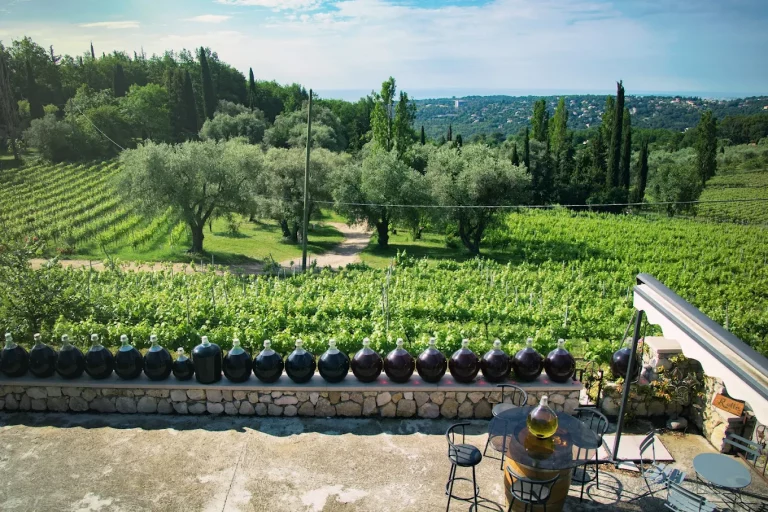
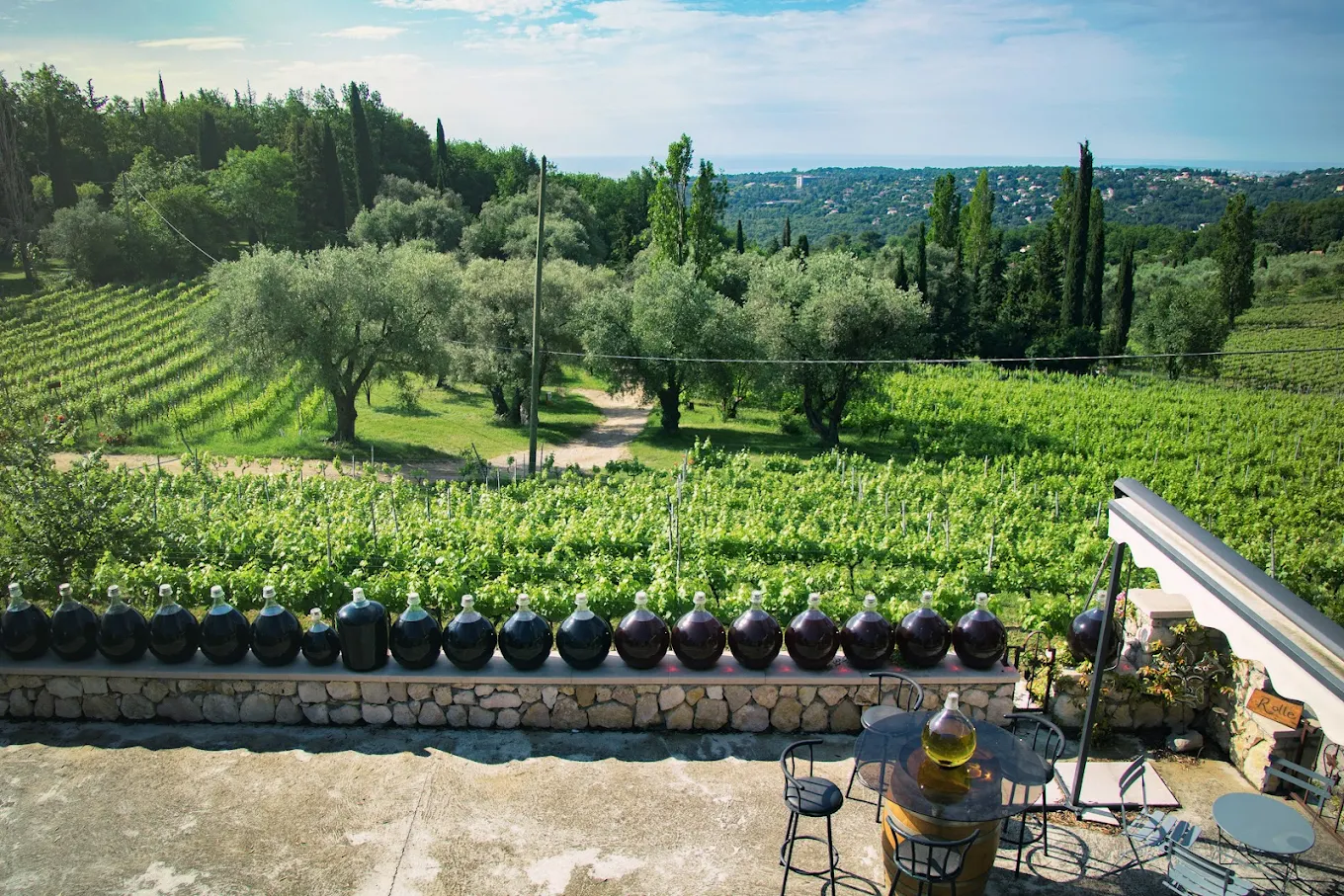
Yes, Domaine des Hautes Collines is an organic vineyard. Our 9 vintages are certified Organic farming (AB label) and wear the’Eurosheet, the European Union's organic logo. On a daily basis, the work in the vineyards is carried out using biodynamics : natural plant-based preparations, lunar calendar, interventions limited to the bare minimum, living soils, biodiversity preserved on the 400m altitude of the hills of Saint-Jeannet, 20 minutes from Nice.
Here is what these commitments actually change in our wines, and what you will see if you come and visit the estate.
The essentials
- Organic certified vineyard (French Organic Farming, certification) Ecocert) And Eurosheet (EU organic logo) on all 9 vintages.
- Grown using biodynamic methods On a daily basis: natural preparations, lunar calendar, cover crops, mechanical soil work, observation rather than systematic treatments.
- Wines without added sulfites on most of the vintages, a unique sun-aging method in Saint-Jeannet.
- Terroir IGP Alpes-Maritimes, 400 m altitude, due south, at 20 minutes from Nice.
- Visits and tastings available all year round., 5 packages ranging from €15 to €50 per person.
Summary
What do the AB and Euroleaf labels guarantee?
THE AB label (Agriculture Biologique) is the French organic certification.’Eurosheet is its European equivalent, mandatory on all organic products sold in the Union. Both logos appear on our labels because the Domaine des Hautes Collines is certified by an accredited independent body, with annual on-site inspection.
In practical terms, this dual certification guarantees:
- No synthetic pesticides No chemical herbicides are allowed on the vines. Copper and sulfur are permitted, in strictly controlled quantities.
- No chemical fertilizers. Fertilization is done with compost and cover crops.
- No GMOs, neither in the vineyards nor in the winemaking process.
- A regulated winemaking : no chaptalization beyond organic limits, addition of sulfites limited to lower thresholds than conventional winemaking, restricted oenological inputs.
- A full traceability from plot to bottle, verified at each audit.
The Euroleaf (the twelve white stars in the shape of a leaf on a green background) also signifies that at least 95% of the product's ingredients are organically grown. For wine, this means 100% of the grapes.
Would you like to taste our organic wines on site?
Biodynamics at the Domaine, in practice
Organic farming establishes a legal framework. biodynamics, This is our day-to-day method. It considers the vine, the soil and their environment as a living whole: we nourish the soil with natural plant-based preparations, we follow the rhythm of the lunar calendar, and we intervene only when the vine needs it, always starting by observing.
What this looks like in the ranks:
- Biodynamic preparations plant-based (horn manure, silica), sprayed in small quantities to revitalize the soil and the vine, following the lunar calendar.
- Plant cover between the rows of vines. They nourish the soil, retain water, and provide a habitat for beneficial insects and pollinators.
- Mechanical soil preparation, No weed killer. The soil breathes, the roots grow deeper, the vine becomes more resistant.
- Weekly observation of each plot during the season. Bordeaux mixture is only treated if the downy mildew or powdery mildew pressure justifies it, never as a systematic preventative measure.
- Manual stripping and thinning to aerate the grape bunches and naturally limit fungal diseases.
- Hand-harvested in crates to preserve the integrity of the grapes and to sort them as they go.
This approach requires more time and more presence in the vineyards. It is also what allows, year after year, the production of wines that precisely express the terroir of Saint-Jeannet rather than a standardized taste.
Wines without added sulfites, really?
The majority of our wines are vinified no added sulfites. This is rare, and it deserves an honest explanation.
Sulfites (SO₄²⁻)2) are used in winemaking for two reasons: to protect the wine from oxidation and to prevent the growth of unwanted bacteria or yeasts. Organic farming allows them, but in lower doses than conventional farming. To go further, that is to say do not add any more, requires additional rigor at each stage.
At the Domaine, several factors contribute to this choice:
- A healthy grapes at harvest, a direct consequence of working in organic and biodynamic agriculture.
- A cool and stable cellar which limits the risks of unwanted fermentation.
- A sun-raising method Developed by Georges Rasse for over 20 years: the wines evolve in jars in the sun, which naturally stabilizes them and gives them unique aromas of spices, nuts, candied fruits.
The result: reds that can be kept for several years, tawny rosés that take on the color of the terroir, naturally sweet wines unique in France. All the wines from the estate are not strictly free of added sulfites, the label specifies this on a case-by-case basis.
Why the Saint-Jeannet terroir is well-suited to organic farming
Organic farming on the French Riviera isn't easy. The humid Mediterranean climate can encourage mildew in the spring. But Saint-Jeannet is a special case.
The domain is perched at an altitude of 400 m, at the foot of the Baou de Saint-Jeannet. Three factors are in our favor:
- The wind. The hillsides are swept by sea and mountain breezes, which quickly dry the foliage after rain. Less stagnant moisture means less fungal pressure.
- The temperature range. Warm days, cool nights: the grapes ripen well, without excess sugar, with precise aromas.
- The soil is calcareous and clay-limestone. It drains naturally, without letting water stagnate. The vine sends its roots deep and finds its minerality.
All of this takes place on south-facing slopes, sheltered from the mistral wind by the Baou mountain. These natural conditions do a large part of the work. Our role is to avoid damaging them.
Visit an organic vineyard 20 minutes from Nice
The Hautes Collines Estate is open to visitors all year round. It is the closest organic vineyard to Nice (20 minutes by car, 30 minutes from the airport, 45 minutes from Cannes or Monaco). Parking is free, and reception is available in French and English.
Five options are available:
- Discovery €15: short tour of the cellar and tasting of 3 vintages.
- Classic €25: full tour of cellar and vineyards, tasting of 5 vintages.
- Picnic in the vineyard €42: walk through the vineyards, tasting, platter of local products facing the panorama (new formula very popular).
- Signature Experience €50: private tour, tasting of the 9 vintages including naturally sweet wines.
For details on packages, schedules and online booking, see the page tasting at Domaine des Hautes Collines. For the complete history of the vineyard and the Rasse family, see the page The Estate.
Ready to come and discover the vineyard?
Frequently Asked Questions
+ Is Domaine des Hautes Collines really certified organic?
Yes. The estate is certified organic by Ecocert, an independent accredited body. All nine wines bear the French AB label and the European Euroleaf. An annual on-site audit verifies compliance with the specifications, from the vines to the bottle.
What is the difference between organic and biodynamic farming?
THE organic (AB label, Euroleaf, Ecocert certified) is an official certification that prohibits pesticides and synthetic fertilizers. biodynamics It goes further: on an organic basis, it adds natural plant-based preparations and respects the lunar calendar, considering the vine and its soil as a living organism. At Domaine des Hautes Collines, our wines are certified organic (Ecocert) and our vineyards cultivated using biodynamic methods.
Are all the wines from the Domaine sulfite-free?
The majority of the wines are made without added sulfites. A few contain very low doses, below organic limits. This is specified on the label for each wine. The sun-aging method developed by Georges Rasse allows the wines to stabilize naturally without the use of sulfites.
+ Can organic wines be bought directly from the estate?
Yes. The estate shop is open Monday to Saturday (9am-12pm and 2:30pm-7pm), and Sunday mornings by appointment. You can taste before you buy during tasting hours. Shipping within France is also available; please contact us directly.
Are there any other organic vineyards near Nice?
The Alpes-Maritimes IGP includes a handful of estates, some of which are organic. Domaine des Hautes Collines is the closest to Nice (20 minutes) and the only one to practice sun-aged wines on jars, a method developed by Georges Rasse over 20 years ago.
+ Does organic food cost more where you live?
Organic farming requires more manual labor and accepts lower yields, which is reflected in the price. Our prices remain affordable and are displayed in the estate shop. Tasting on-site is the best way to get a feel for our wines before buying.
About the author
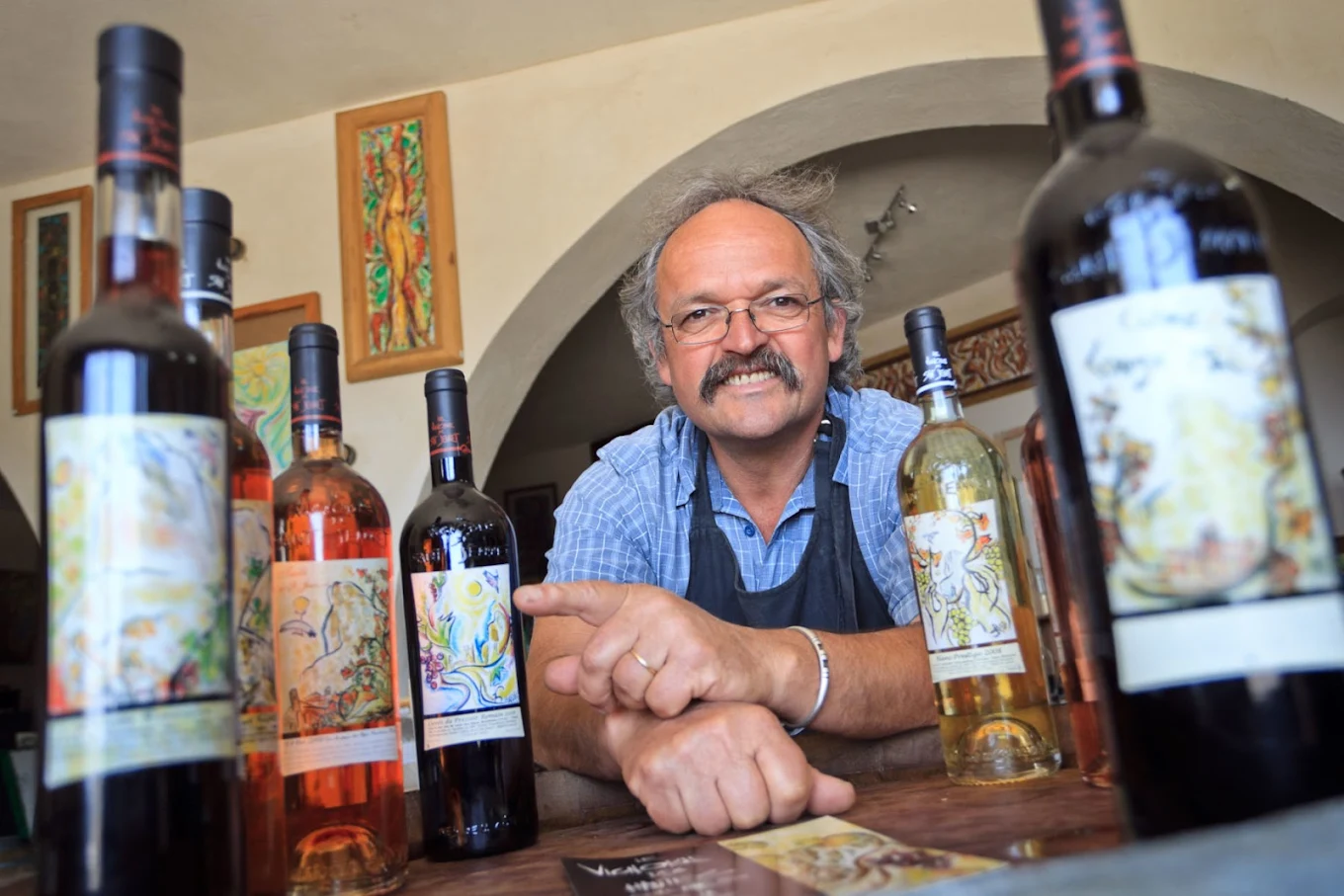
Georges Rasse
A passionate winemaker and founder of Domaine des Hautes Collines in Saint-Jeannet, he planted his first vines in 2000 in the hills of the Alpes-Maritimes and, with his son Mathias, continues to uphold traditional organic and biodynamic winemaking practices. They produce nine wines certified organic (AB), Euroleaf, and Ecocert, including the renowned natural sun-stabilized wines, a long-standing Saint-Jeannet tradition.